We all know the symbol with a vertical line in a circle: it identifies the On/Off power switch. It occurred to me that this familiar symbol is evolving in a bizarre fashion.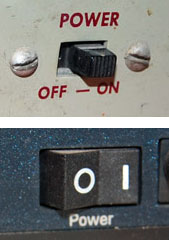
Originally, switches had a lever or slider that could move to either of two physical positions. In those days the switch was marked with the word POWER and its positions with ON and OFF. Then, as switches became smaller and more globalized, the two words were replaced with 1 and 0, as seen even today on many rocker switches.
And then the ubiquity of microprocessors made it more economic to do everything with momentary pushbutton switches; the computer inside could take care of figuring whether you meant ON or OFF. And so, the button now needed an icon that conveys both options; I surmise that is when the familiar “1-inside-a-0” symbol came into existence (if you know otherwise do share in the comments!) This round icon fit nicely on round buttons, and became ubiquitous.
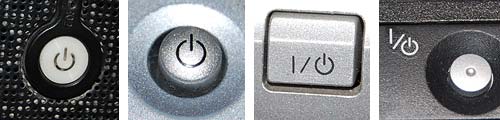
But then we start to see the form shown in the two photos above right: a bastardized version combining the 1-in-a-circle with a 1 in the same symbol. This makes no sense at all – the correct representation would have been 1/0, for On slash Off. Instead we get On slash OnOff. Sloppy thinking…
Such erroneous contractions are often seen in spoken language – as in “IT technology”, which expands to “information technology technology” (there’s even a company by that name, and its slogan, amusingly, is “We make sense of IT“). But now we see the same error invading the more compact space of visual symbols…




I believe the intention of the symbols changing on the switch to a “1” & a “0” is directly related to our society breaking into a new technological age, which has only been possible through computers, and a computers’ native language is binary. (Zeroes ones).
The cirlce and line stand for 0 and 1 in binary. The switch we recognize as “on-off” was originally meant to indicate a button that put a device into a low power or sleep state. A true on-off symbol would be a closed 0 with a 1 inside it. So those buttons are probably correctly showing an on-sleep switch.
There’s actually an organization in charge of this.
http://en.wikipedia.org/wiki/International_Electrotechnical_Commission
http://en.wikipedia.org/wiki/Power_symbol
If you’ve designed UI then you know why its one button… the original icons were useless. Does O mean Off? Does O mean light? Does l mean screen is collapsing to off? Does it mean a switch connection? Nobody knows. That’s why the toggle switch worked. People have no idea what the l and O icons mean. That’s just some bad ui design for techies. design by committee. I’ll bet if you ask 10 people on the street what O and l mean then you’ll not get even 70% getting it right. So, the combined symbol now means “change power state”. And user still have to guess what that means WRT hibernate/sleep (platform prompts them often).
Great post! But I have a weird question about this. Why use the words “ON” and “OFF”? Going back to an era before the traditional switch, maybe even as far back as kerosene lamps, when you ignited something, was it always called ON and so forth? Why call it an ON/OFF switch and not a START/STOP or IGNITE/EXTINGUISH?
Oh. I always thought this means power (masculine) and this is a sketch of male and female organs in an intercourse, just like male and female sockets. Thanks for valuable info.
Good question, Jul! I admit I have no idea!…
Ok, now tell me why one side of a plug is larger and only fits into the outlet one way. Years ago this wasn’t the case. Has anyone EVER in their lifetime plugged something in the right way the first time? What about when you have to plug something in that is awkward and difficult to see? You never know which way to hold the plug. What difference does it make anyway?
@dennis, this is off topic, but I believe the polarized plug is meant to control which of the wires has the “Live” side of the mains and which the neutral – a potential matter of life and death in case of a leak to the casing of the appliance (not critical in double insulated appliances, though).
O & I represent simply IN & OUT
what the whole ruckus about!
simply derived from the toilet door or just any thing which shows the status (Position) of the commodity (which in case here it is power / current). O – Current is Out of the device. I – Current is in the device!
“O” refers to an “open circuit” in which current cannot pass through, so the device is OFF.
“1” is not a “one”, but is a vertical bar symbolizing a “closed circuit”, in which current will pass through, so the device is ON.
An electrical circuit is either Open or Closed. Think of a light switch. When the switch is open, current cannot pass through, so the switch is off. When the switch is closed and metal contacts touch, then the circuit is closed and current is running through it.
This is just ridiculous. Why should people have to try to remember or come up with some memory aid to figure out which of the symbols means on and which means off. Just use your words and put “On” and “Off” on the switch! Sheesh!
I’ve always wondered about the origin of these symbols hence ending up here, after much searching but looking for the letters I & O not numbers. My query re numbers is, fine with the written number being a single line but on a keyboard I don’t think I’ve ever seen the number 1 typed as a single line so how did this come to be?? Numbers and letters aside though, with vertical switches up is always off and down always on – with horizontal ones left is always off and right on. The only exception being with multiple vertical switches to the same power source such as household lights – as far as I’ve seen anyway. A great thread, it was very interesting!
Great informative post.
But one thing that confuses me is that many people in the comments have said that O stands for the open circuit and 1 is basically a straight line that represents a closed circuit.
But how do we know, which notation came first?
Was it 0 for open circuit or 0 for off switch.
Maybe, 0 was considered off switch and when they decided to give a symbol for an open circuit, they gave 0 since no current is flowing in both cases, or was it the opposite scenario, or were both given at the same time.
Thanks.
All in all, a very interesting thread.
What a farce!!!!!! 1 means on and O means off. Why can’t power tool manufacturers simple put “on and Off”? Nowhere in the manufacturer’s manuals do they tell you that “1” means “on” and “O” means “off”. Who is the dummy here?
Right, I’m old enough to remember switches marked I and O for starters. I’ve been thinking about what ( as has already been pointed out) is the ‘stand by’ switch, symbolically speaking, I get the binary argument and the more traditional electrical current perspective ( and the ‘seen on a UFO’ argument). I love ikea instructions – the little symbols used to transcend language (to save on printing costs in the globalised consumer market) – a simple visual prompt.
This power button thing ? Think of the line as a finger and the circle (or broken circle) as a button – the finger is pushing the button.
Push the button ? Go on, as someone pointed out above , you’ll soon work out if it’s on or not
It isn’t a “1” or an “O” it’s a line that indicates closed circuit or a circle for closed circuit or what “on/off” looks like on a wiring diagram or schematic.
What the fuss is all about is that I have some Electrical Workers that can not figure out a rocker switch with the Power sign indicate a simple no brainer except my electricians do not pay attention to little problems of which become big problems when the systems fail to light such in solar power arrays.
Below the Rocker Switch is marked POWER, and then the Rocker switch indicates a 1 below and a O above. A simple test of the switch with an OHM Meter will indicate ON or OFF when the switch is toggled. Well thank for genuises
If you want to know the real answer, consult a technical source. Don’t read what people have posted here. Of the 70 responses logged up until now, only one is really correct and all it gives is a web URL. The circle and line is a SYMBOL, and it is a symbol so it can be internationally accepted and standardized. Guess what? It is exactly that. An international, multi-lingual group DECIDED on this symbol AND they explained their reason for adopting this symbol. We don’t need to go back to English ON and OFF. The circle represents a binary zero and the line represents a binary one. The combination symbol means the button does not truly disconnect from power. You should already know how to push it one or more times and / or hold it down. If not, get a techie to explain it to you.
So after reading all these ideas. No one so far has Clearly explained which is off which is on and do you push the toggle switch in to turn the unit off using the o or line.
Mist tools or machine I’ve used that have these STUPID markings work differently so why not Keep It Simple Stupid! Since English is still the universal language. Have switches or levers or valves marked with what the are intended to do!!!!
So simple !
There are many devices that still require the rocker switch and thus still use the the I/O symbol. (And by the way, it has nothing to do with representing an open or closed electric circuit; see the Wikipedia article on “Power switch” which will confirm it was chosen as an abstraction of the binary numerals 1 and 0.
Anyway, so gadgets such as power tools (for example the new router I just bought for woodworking) still require a rocker switch. And since no ordinary person thinks in binary, the “1/0” notation is confusing. And what’s bad about that is, you really need to know *before* you plug in a power tool whether the switch is on or off – if you plug it in with the switch in the “on” position, very bad things can happen, e.g. serious injury, damage to the device or surroundings, etc.
So I join in the general condemnation of what amounts to an international “stupid symbol by committee.”
There was only one correct answer in all the replies about switch symbols, namely that the two letters are I for In and O for Out. These derive from the earliest knife-style electrical switches, which were considered to be closed when the knife blade was pushed IN and open when the knife blade was pulled OUT. Thus the “I” means the switch is closed or ON and “O” means the switch is open or OFF. This terminology originated in Britain and is still used there. None of the supposed explanations about being binary code are correct.
Haha, i have the same design as my company logo @ http://www.necmar.nl
What do you think about the design ?
Necap
So I just had a company logo made for my coffee company. I like the way it looks but it incorporates the standby symbol. Do you feel this a bad choice and that it says low power state, as opposed to power on. I have it drawn in its illuminated state and hoped that it would be received as “power on”. Feelings, comments?
Just plain ridiculous !!! Was on/off so confusing that it had to be changed to o/I ?? I am constantly getting people dropping off new pressure washers, and gas generators, for “no start” conditions, only to find that they have been trying to start them in the off position, since “O” would be a 50/50 shot of meaning on or off. A gas powered tool is not close to being a computer. You know the old saying, “IF IT AIN’T BROKE,DON’T FIX IT”
The I overlapping the O is not on/off, but standby, indicating the device is not fully off when the switch is pressed. A toggle switch which fully turns the device on or off is an I fully enclosed by an O. The pictured switches with I/O and I probably attempt to show that the device can be toggled on standby or completely turned on/off, since there was a point when devices were shipping with standby switches which turn the device fully off when held for multiple seconds.
it still doesn,t answer the question,WHY I for on,why not just stick to ON and OFF, I thought this was supposed to be design simplified. instead of trying to figure whether O means OFF, or ON.
My sensibility says that O, a circle, should represent a complete circuit. Ergo- ON
I or – should represent unterminated ends, an Incomplete circuit. Ergo-OFF
I guess that’s why the world makes no sense to me.
Do you have any reference about I/O icon?
I couldn’t search any history that power switch symbolizes 1 or 0.
@Maxweber,
Long ago people had no idea what an “alt” key was, but if people see something enough, believe it or not they will usually find out. In the case of switches it’s generally quite easy to find out, and then you know. It could really be a B and a V, and so long as that same switch always worked the same way most users would be fine. The I and O symbols are the actual electrical standard. If people on the street are ignorant of this, they will learn. And that’s OK!